
African Roots — A Legacy of Resistance and Culture
Photographing Salvador has never been just about walking through the city with a camera. Salvador is where I was born, where I grew up, and where I learned how to look at the world. Every street, every alley, every face and every gesture carries something from my childhood, from my formation, from my roots. That is why photographing this city feels different from photographing anywhere else.
In Salvador, everything seems to have meaning. The food, the dance, the faith, the body, the clothes, the colors, the way people walk, the pride of belonging. Everything speaks. Everything tells a story. And many of those stories I recognize before I even press the shutter, because they are also part of me.
African Roots was born from this encounter with my own origins. It was not created to show Afro-Brazilian culture as something distant, exotic or inferior. Quite the opposite. The purpose is to show the greatness of this culture, the strength of Black people, the beauty of African heritage in Bahia, and how much our identity owes to this presence. In Salvador, Africa is not only in books or in memory. It is in the body, in faith, in music, in work, in food, in clothing, in people’s eyes and in their hearts.
Many times, while photographing, I felt deeply moved. What first seemed like work became pleasure, encounter and recognition. At the same time, it was difficult to choose what to photograph, because everything was happening at once. A gesture, a hand, a building, a landscape, a face, an expression. Everything seemed to ask for a photograph.
One of the images that marked me the most was that of a fisherman at the fishing colony in Pituba. I had passed by that place many times in my life. I had bought fish there, seen those men working, but perhaps I had never really stopped to understand their importance. That morning, I went out very early to photograph. The day was just beginning, but that man had already gone out to sea, returned with the fish, separated what he would sell and what he would take home. He told me he had started working around two in the morning. He spoke with pride, calmness and joy.
His hands were marked by salt, sun, fish cuts, time and work. They were hard, calloused hands, but full of dignity. In that moment, I understood that the image was not only about a fisherman. It was about work, survival, food, family and continuity. It was about a Black man sustaining his own life and helping sustain the lives of many people around him, including people from middle-class neighborhoods who often pass by without truly seeing him.
Another scene that stayed with me happened in Pelourinho. I spoke for almost forty minutes with a Black woman who worked there serving tourists and locals in the historic center. She was a single mother, she studied, she worked and she fought for her own survival. She was beautiful, well dressed, wearing clothes that carried references to Afro-Bahian culture and to the memory of her grandparents and great-grandparents. There was self-esteem in her, strength and a life project.
At the same time, that scene carried a deep contradiction. A Black woman, dressed with references to her ancestry, working in the historic center of Salvador, surrounded by tourists, colonial architecture, symbols of a painful past and a culture that resists every day. She smiled, served people and kept going. But behind that smile there was struggle, motherhood, abandonment, work and dignity. This mixture of beauty and pain is also part of Bahia.
In Pelourinho, another image was born from this coexistence between faith, body and celebration. A man appeared carrying saints, between Cravinho, Olodum, music and the street. I titled the photograph Lust and Faith, because it seemed to hold something essential about Bahia. Faith and pleasure living side by side without guilt. The sacred and the body sharing the same space. A people who pray while dancing, who celebrate as a form of resistance, who transform pain into rhythm, devotion, desire and ancestry.
African Roots is, for me, a work about belonging. It is about returning to Salvador and realizing that I recognize those gestures, those bodies, those voices, those paths. It is as if each image takes me back to another time, to the streets I walked when I was younger, to the people who shaped my way of seeing, and to the city that taught me how to feel.
When I return to Salvador, I do not simply recharge my energy. I find myself again. I know where I come from. I recognize the people, the city, the strength and the beauty that shaped me. For me, Salvador is this: memory, roots, contradiction, faith, work, joy, pain, resistance and pride.

IPA 2026 HONORABLE MENTION
International Photography Awards
African Roots: Faith, Resistance and Continuity
Professional — People / Traditions & Culture
This documentary series received an Honorable Mention at the International Photography Awards 2026. The work explores faith, resistance, ancestry and cultural continuity in Salvador, Bahia, Brazil.
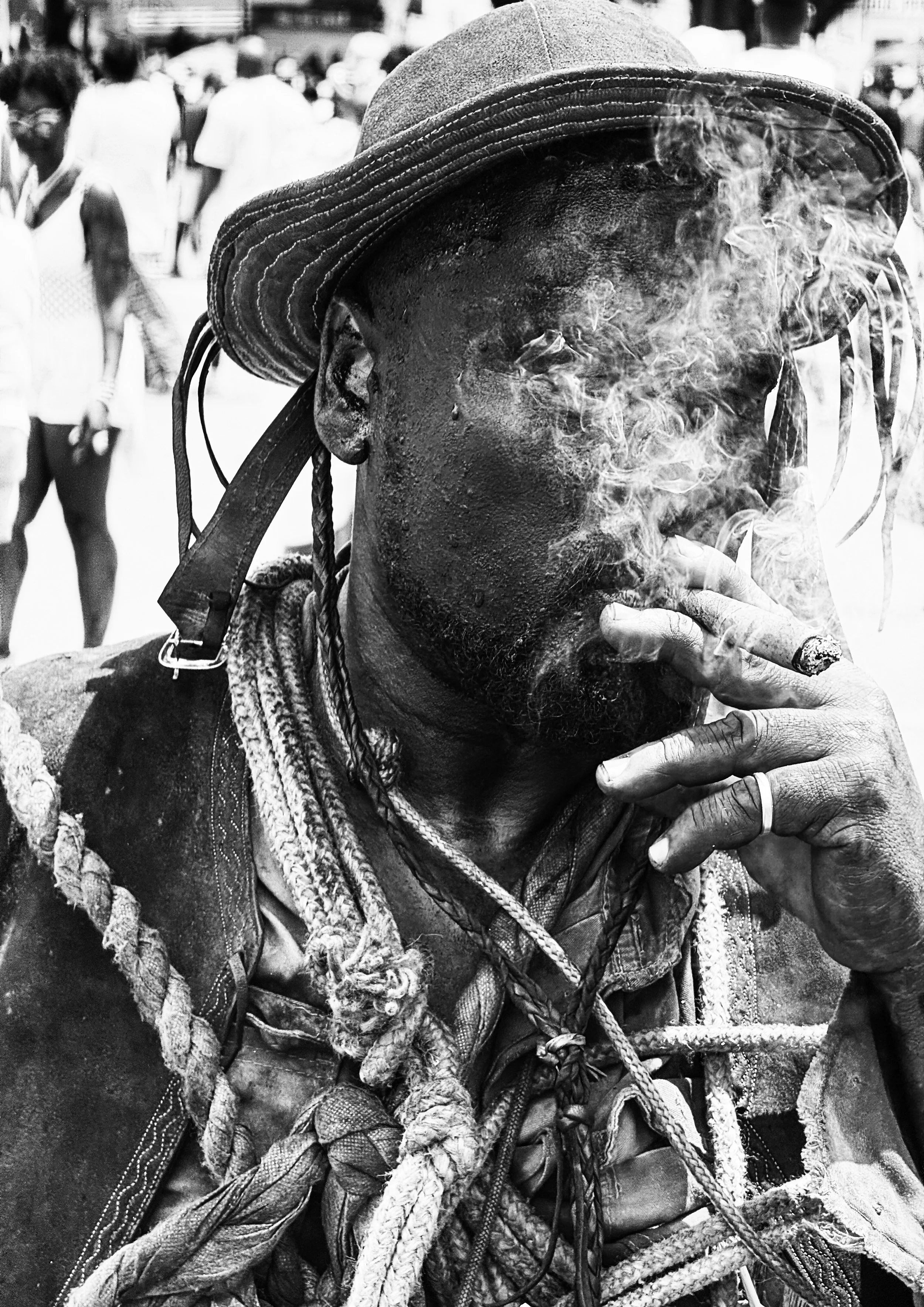
Smoking Man
This is a documentary portrait of an Afro-Bahian man, captured in a working-class urban context in Brazil. The image highlights striking features of Afro-Brazilian identity, emphasizing expression, adornments, and the presence of the body as a narrative element.
Smoke acts as a visual and symbolic element, creating layers that engage with resistance, ancestry, and social invisibility. The photograph articulates aesthetics and documentation, situating the individual between tradition, marginalization, and cultural affirmation.
The work is part of the project African Roots: A Legacy of Resistance and Culture and received international recognition, with participation in the book “Urban Unveils the City and Its Secrets” (Urban Photo Awards), in addition to exhibitions in Italy and Japan.
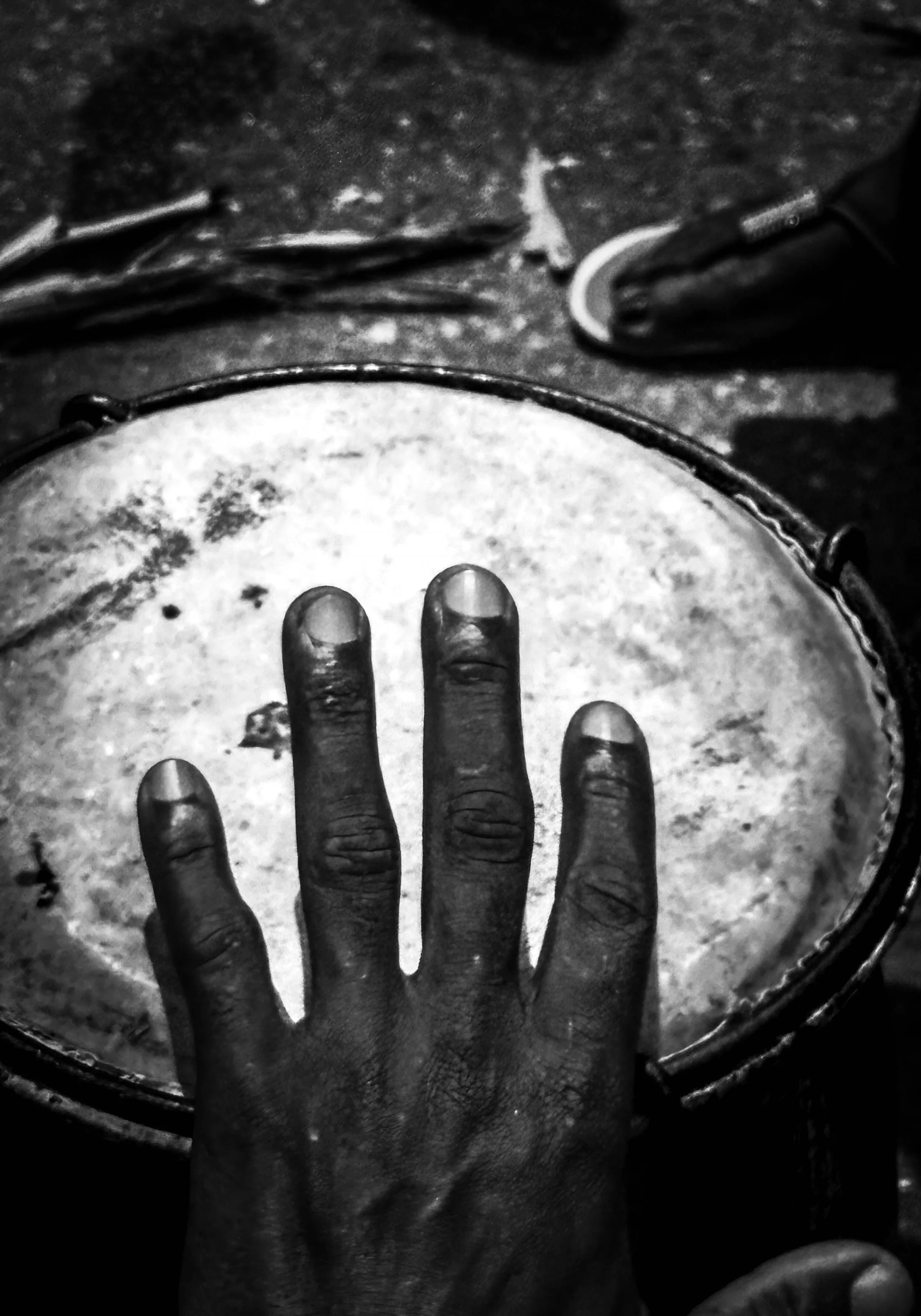
Hands on the Drum
Hands on the Drum
This documentary photograph captures the direct gesture of a hand on a drum, a central element in Afro-Brazilian cultural and religious practices. The image emphasizes the physical contact between body and instrument, where sound is born from touch, repetition, and ancestral memory.
The composition favors close-up framing and the use of black and white to highlight texture, contrast, and the intensity of the gesture. This technical choice eliminates distractions and directs the eye to the relationship between skin and surface, emphasizing rhythm as a visual language.
The drum, in this context, is not merely an instrument, but a vehicle for spiritual communication, collective identity, and cultural resistance. The photograph captures the moment when tradition and body meet, revealing the continuity of practices that span generations.
The work is part of the project African Roots: A Legacy of Resistance and Culture, establishing itself as part of a visual narrative that documents faith, expression, and the permanence of Afro-Brazilian culture.
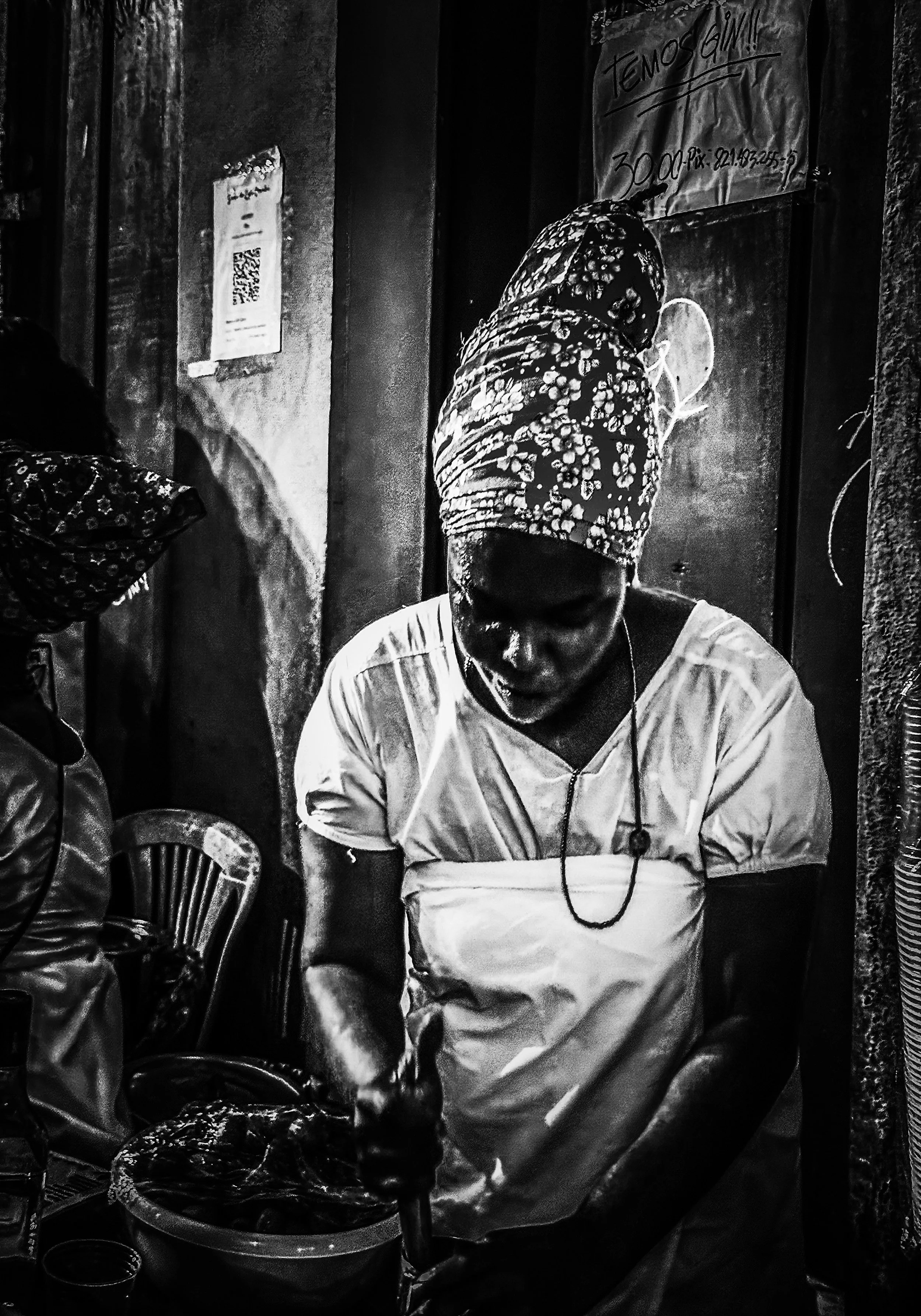
Hands that Feed
Hands that Feed
Documentary photograph depicting the everyday act of food preparation, performed by an Afro-Brazilian woman in a working-class context. The image highlights manual labor as an expression of sustenance, care, and cultural continuity.
The composition uses vertical framing and controlled close-up shots, allowing for a simultaneous reading of the character's gesture and presence. The use of black and white reinforces the visual structure of the scene, highlighting contrast, texture, and the relationship between light and matter.
In this context, the act of cooking transcends its practical function and becomes a cultural and ancestral practice, especially within the Afro-Brazilian context, where food is directly linked to memory, spirituality, and community.
The photograph is part of the project. African Roots: A Legacy of Resistance and Culture, creating a visual narrative that highlights the central role of Black women in preserving knowledge, traditions, and forms of resistance in everyday life.
SALVADOR - BAHIA - BRAZIL
*
SALVADOR - BAHIA - BRAZIL *
By Michel Soares