
This essay stems from my personal connection to Salvador, the city where I was born and where my perspective on the world was shaped. "African Roots" is more than just a photobook. It is a reunion with memory, a reunion with Afro-Bahian culture, and a reunion with people who embody the power of a generations-old heritage in their bodies and daily lives.
For me, photographing Salvador is not simply about walking around the city with a camera. Salvador is where I was born, raised, and where my worldview was shaped. Every street, every alley, every face, every gesture tells the story of my childhood, my upbringing, and my roots. That's why photographing this city is completely different from photographing any other place.
In Salvador, everything seems to have meaning. Food, dance, faith, body, clothing, colors, gait, and a sense of belonging. Everything speaks to us. Everything weaves a story. And I can recognize many of those stories even before I take the photograph, because they are a part of me.
This reunion gave birth to the "African Roots" series. It was not intended to portray Afro-Brazilian culture as something distant, exotic, and inferior. Quite the opposite, in fact. Its purpose is to show the splendor of this culture, the strength of the Black people, the beauty of African heritage in Bahia, and how deeply rooted our identity is in this culture. In Salvador, Africa is not confined to books or memories. It lives on in people's bodies, beliefs, music, work, food, clothing, gazes, and hearts.
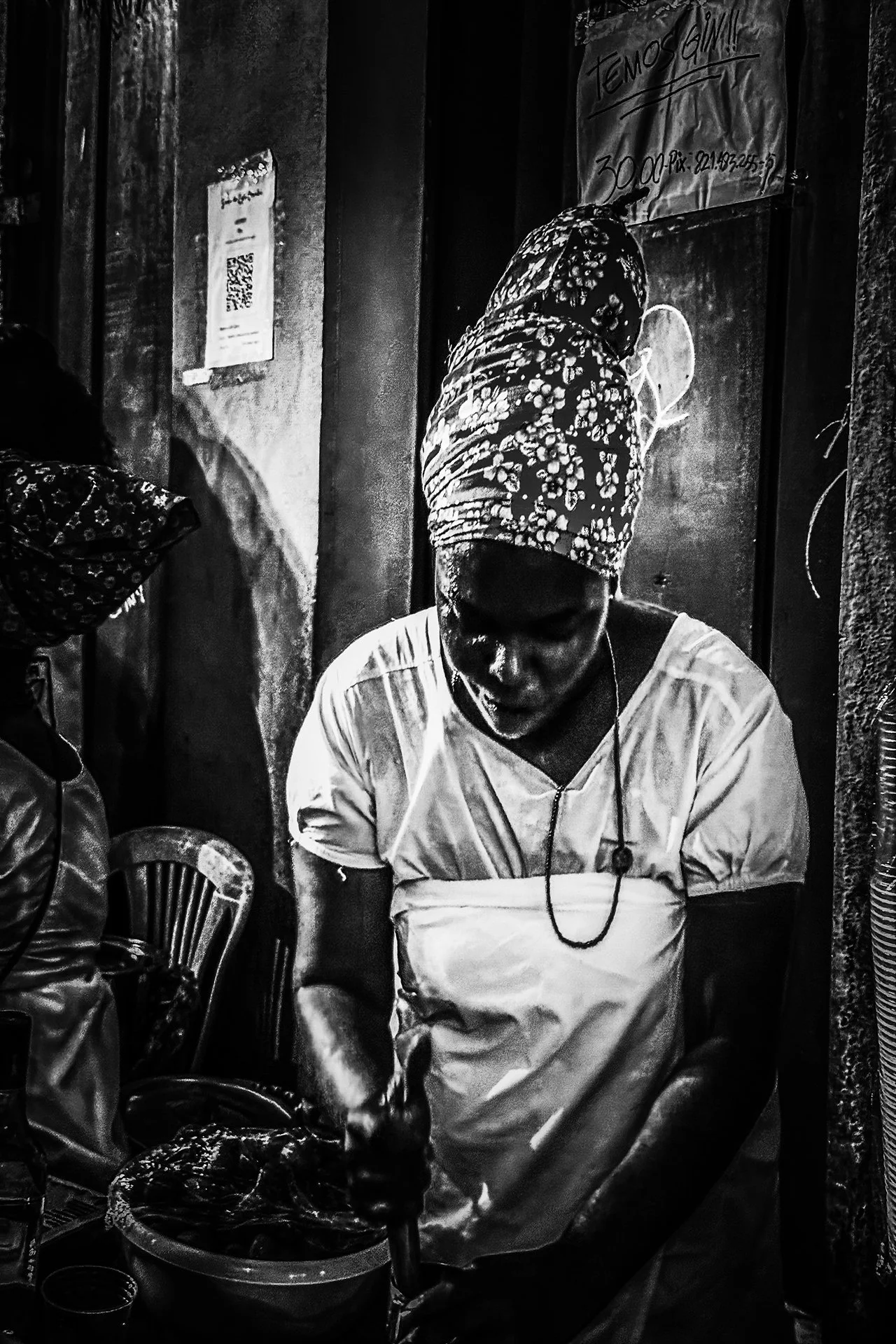
Women working in Pelourinho, Salvador. Their bodies, faith, work, and ancestors are deeply rooted in the daily life of this city.
While taking photographs, I often became emotional. What seemed like work transformed into joy, connection, and empathy. At the same time, it was difficult to choose what to photograph because everything was happening simultaneously: gestures, hands, architecture, landscapes, faces, expressions. It felt as if everything wanted to be captured in the photograph.
One of the most memorable sights was that of the fishermen in the fishing village of Pituba. I had passed through that place many times before, bought fish, and seen the fishermen at work, but perhaps I had never stopped to truly understand the importance of their existence. That day, I went out early in the morning to take photographs. It was still early morning, but the fisherman had already gone out to sea, caught fish, and returned, sorting what to sell from what to take home. He told me that he started work around 2 a.m., before dawn. He spoke with pride, serenity, and joy.
His hands were covered in the traces of salt, sun, fish preparation, time, and labor. They were rough, calloused hands, yet they exuded dignity. It was then that I realized this was not just a picture of a fisherman. It was a story of labor, survival, food, family, and continuity. It was a picture of a Black man sustaining his own life, and sustaining the lives of many around him, especially the middle class who passed him by without even noticing.
Another memorable experience was in Pelourinho. I spoke for nearly 40 minutes with a Black woman who was providing services to tourists and locals in the historic district. She was a single mother, studying and working, struggling to make ends meet. She was beautiful, well-dressed, and her clothing evoked memories of Afro-Bahian culture, specifically her grandparents and great-grandparents. She possessed self-esteem and strength, and had a clear plan for the future.
At the same time, a profound contradiction lay beneath the surface of the scene. A Black woman, dressed in attire reminiscent of her ancestors, worked in Salvador's historic district, surrounded by tourists, colonial architecture, symbols of a difficult past, and a culture that continued to resist day after day. She smiled, served, and moved forward. But behind that smile lay struggle, motherhood, the experience of abandonment, labor, and dignity. This blend of beauty and suffering is also a characteristic found in the state of Bahia.
In Pelourinho, another image emerged from the coexistence of faith, body, and celebration. Amid the claviño, olodum, music, and the hustle and bustle of the city, a man carrying a statue of a saint appeared. The photograph was titled "Desire and Faith," because it seemed to symbolize the very essence of Bahia. Faith and pleasure coexisting without guilt. The sacred and the body occupying the same space. People praying while dancing, celebrating while resisting, transforming pain into rhythm, devotion, desire, and respect for their ancestors.
For me, "African Roots" is a work about belonging. It's a work about returning to Salvador and realizing that the gestures, bodies, voices, and paths I walked there are all familiar. It's as if each photograph is taking me back to the past: to the paths I walked in my youth, to the people who shaped my worldview, and to the city that taught me about emotions.
When I return to Salvador, it's not just about recharging my energy; it's about self-reflection. I rediscover where I come from and reaffirm the people, the city, the strength, and the beauty that shaped me. For me, Salvador symbolizes memories, roots, contradictions, faith, work, joy, suffering, resistance, and pride.
See all works here: African Roots
